
Playing College Basketball
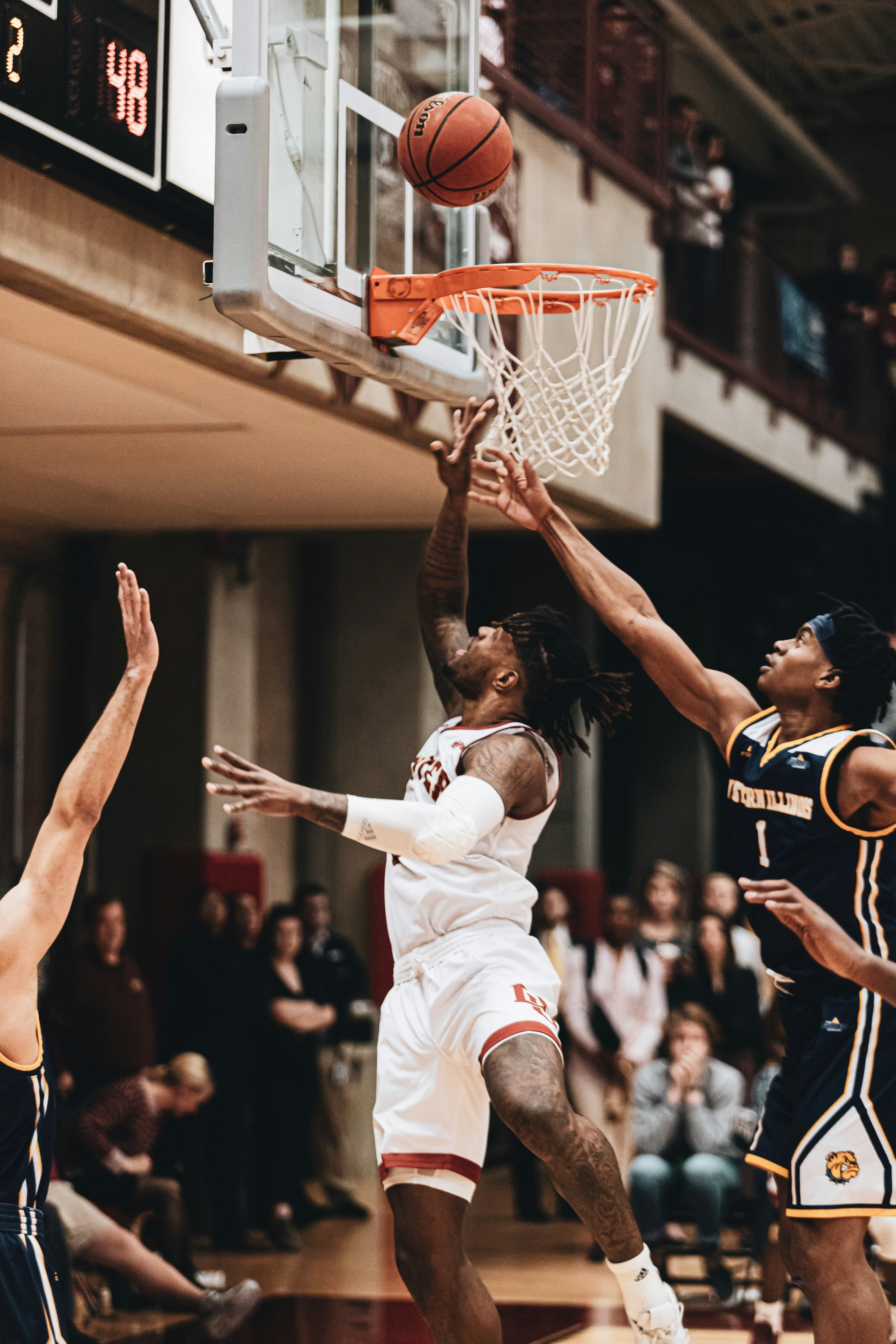
The difference between high school and college basketball can be quite a shock for some players, and this change can sometimes effect a player well into their freshmen year, and beyond. In too many cases it has also led to players transferring schools, or dropg down to a lower division. So what can you do as a player to make sure that you are prepared to play at the college basketball level?
This is something that every high school player should be thinking about that plans to play at the next level. The answer to that question comes in two parts. First you must identify the differences between high school and college basketball, and then you must prepare yourself to adapt to those changes.
The goal of this article is to give you 8 of the biggest differences that you must be ready for as you progress into playing college basketball. This will hopefully help to set you up to have a successful college playing career.
Offensive Spacing
For most players the offensive spacing in the half court is the biggest on court adjustment that will occur when playing in college. There is no longer the space to take 5 or 6 dribbles before trying to score on your man. College defenses are all about being in the gap, help, and rotating on penetration. So if you try to isolate every time you catch the ball, you are going to be forced into a bad shot because the defense is set and ready for you. There will be end of clock situations where you may need to make an isolation move, but all of your time in the gym should not be spent working just on these types of moves.
This means that you need to find other ways to score in the half court and adjust to the help defense. So instead of trying to attack one on one, attack off of a quick reversal, a hard cut, catch and shoot, etc. You need to be able to adjust your game so that you can get quality shots within the offense. Here are a few scoring opportunities that are going to be available in a college basketball game (broken down by position).
Guards/Wings
-
Shooting or attacking off of a quick reversal
-
Hard cuts (must read the defense)
-
Using ball screens and off ball screens
-
Sprinting the floor in transition
Recommended: Moving Without the Ball in Basketball
Post Players
-
Hard duck ins for deep post catches
-
Setting great screens and then opening up to the ball
-
Rotating for a dump off pass on guard penetration
-
Offensive rebounds
Recommended: Post Move Drills
Accounting for the Help Defense
College coaches pride themselves in having a defense that is able to be in the gap or in the help, and most college teams are pretty good at this. That means that as a player you need to be able to account for that help defense, guards especially. As a guard, when you get past your defender in the half court, you are most likely (99% of the time) going to have another defender stepg up to help, and in most cases it is going to be a 6'11 shot blocker, or a player that seems to always be in the right place to take a charge.
So when you get past your primary defender, you need to know what you are going to do with the ball. Your two main options are going to be pass to an open teammate, or look to finish yourself. It is important that you are able to do both so that the defense isn't able to force you into one option. i.e. If you always kick out to a teammate the defense will not help off, or if you only look to finish on the drive, the defense will collapse and make you take a bad shot.
On the finish you want to be able to shoot the highest percentage shot, so that most likely doesn't mean driving right into the shot blockers body to finish. This is where a great floater and runner come into play. These two finishes allow you to get past the first level of defense (your defender), and then get a quality finish before reaching the second level of defense (the shot blocker/player taking a charge). Whatever move you decide to use, make sure that you stay under control, and recognize that there is almost always going to be a help defender that you must account for.
Finding your Role
The majority of the players on a college basketball team were the best player on their high school or prep team. That means that every player is coming in and trying to establish their role on the team. Even more, you are most likely going to be one of a few freshmen joining a team of upper class men that already have established roles on the team. So how do you earn and establish the role that you want on the team?
Every players role is going to be different, but coming into college you have a big impact on the type of role that you want with your team. If you want to have a bigger role on your team you must to be willing to put in the work and be willing to step up every day at practice, workouts, etc. With 14 other players competing for minutes and shots, you are going to have to earn your role on the team.
Another big key to finding or establishing your role, is what you do outside of team practice times. The NCAA regulates how much time your coaches are allowed to have with you on the court during the season and off season (2 hours per week on the court during the off season, and 20 hours per week during the playing season). That means that you need to be committed to putting in work on your own time, if you really want to excel and have a bigger role with your team.
Time Commitment
One of the hardest things for players to get used to in college is the time commitment that comes with it. You are a student athlete and that means that there is more than just basketball that you are responsible for. When you add up these other responsibilities; going to class, practice, weights, individual skill development, study hall, and 3 meals a day you aren't left with much free time. It is important that you recognize this, and learn to manage your time well. Don't allow one of these areas to suffer by not budgeting enough time for it, you must find a way to balance all of them.
The Distractions
The higher the level you play at in college the more this becomes a concern. Too many players allow what really matters to suffer and fall apart because they allow too many distractions into their life. Whether it is friends, parties, video games, etc. you need to be able to manage the distractions. There are always going to be people that want your time and there is nothing wrong with taking a break and having free time, but don't allow these things to negatively effect your on the court or classroom performance.
“Is what I’m doing or about to do, getting me closer to my [true] objective?“ – Robert Townsend
The Grind
The day in and day out grind of college basketball, school, and everything else that comes with it can sometimes be a lot, especially for freshmen. It is important though that you are ready for this, and also prepared to battle through it when it hits. There may come a time during the season where you just feel mentally drained and fatigued, it happens to a lot of players (even non freshmen).
However, it is important that you are first able to continue to fight through it, and then secondly recharge yourself. Do what you need to do to get back mentally and physically so that you can play your best. A big part of this is what you do off the court in taking care of your body. Spend the needed time stretching, getting preventive treatment, ice baths, foam rolling, etc. You must be willing to invest in yourself, and take care of your body for the long grind of the season.
Recommended: The Importance of Stretching in Basketball
Next Man Up
One of the great things about college basketball is the length of the season, and the fact that no role is permanent. During the course of the season you may not be playing very much, or have the role on your team that you want, but that doesn't mean you should pack it in and wait till next season. In fact it means the exact opposite. You need to be working on your game and staying ready for when your chance comes. I can't tell you how many players that I have seen that were barely playing at the beginning of the season, and then ended up playing a huge role on the team by the end of the year. So always be ready to go if your chance comes.
"I don't complain about playing time. My job is to play so well the coach can't sit me." - Shane Battier
Understanding the Process
As freshmen you are most likely going to have certain areas of your game that need development, and that takes time. Some of these deficiencies may even keep you from playing, or having the roll that you want with your team. It is important though that you understand the process, and stay committed to getting better and develog. Not every player comes in as freshmen and has immediate impact on their team's success. Whether you do or don't though, it is important that you understand that it is a process to get to where you want to be as a player.
Want unlimited access to 800+ basketball drills, workout plans, and coaching breakdowns?
Built by college and pro coaches. 7-day free trial — cancel anytime, no questions.
Start Free Trial